Shin-Osaka Station Guide: JR, Metro & Shinkansen

Shin-Osaka is Osaka's Shinkansen station; Osaka Station in Umeda is a separate station. If your ticket is for the Tokaido or Sanyo Shinkansen, search and navigate to Shin-Osaka. From there, use a suitable JR service for Osaka/Umeda or the Osaka Metro Midosuji Line for destinations such as Namba and Tennoji.
Contents: Station overview · Getting there · Gates and transfers · JR Pass · Food · FAQ
Shin-Osaka station overview
Shin-Osaka connects the Tokaido and Sanyo Shinkansen with JR conventional trains and Osaka Metro station M13 on the Midosuji Line. Some Shinkansen services continue beyond Osaka, while others start or finish here. Check the train's destination and your ticket rather than assuming you must change at the boundary between the two Shinkansen lines.
Use the JR Central English station map together with the JR West Shin-Osaka map and platform guide. JR West's current map page labels its plan October 1, 2026. Maps show layout and facilities; your train's actual platform comes from the departure display and current announcements.
Getting to Shin-Osaka
| Starting point or next destination | What to look for | Before boarding |
|---|---|---|
| Osaka Station / Umeda | A JR service linking Osaka and Shin-Osaka, or Midosuji Line between Umeda and Shin-Osaka | Confirm the station entrance, direction and service stops |
| Namba or Tennoji | Midosuji Line toward Nakamozu | Check Metro departure information and pay the applicable Metro fare |
| Kyoto | JR Kyoto Line or an eligible Shinkansen service | Conventional trains and Shinkansen use different platforms, gates and ticket products |
| Kansai Airport | A suitable HARUKA service or another planned connection | Confirm the dated timetable and required limited-express/seat tickets |
| Tokyo / Nagoya, or Hiroshima / Hakata | Tokaido or Sanyo Shinkansen respectively | Match the train number, departure time and ticket to the display |
The official Metro Shin-Osaka page provides current station maps, directions toward Nakamozu and Minoh-kayano, and accessible entrance routes. A hotel near “Osaka” is not necessarily within walking distance of Shin-Osaka; check the exact address.
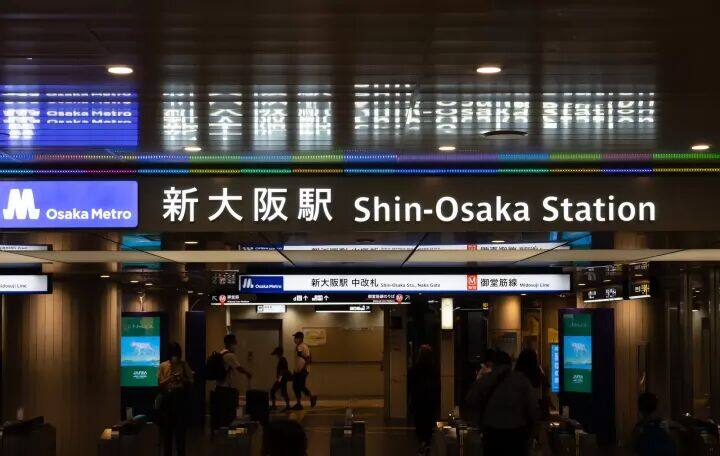
Existing photo of the Metro entrance for orientation. Follow current signs and the official station map for your route.
Shin-Osaka versus Osaka Station
Shin-Osaka is the high-speed rail stop. Osaka Station is the JR hub in the Umeda area, with separate nearby Metro and private-rail stations. Do not confuse the similarly named Osaka and Shin-Osaka stations when booking or arranging a meeting.
The two are linked by rail, but allow time for walking, waiting and your ticket arrangements. A ticket marked only for a Shinkansen segment does not necessarily include the JR journey to Osaka Station. For Tokyo travel, see the Tokyo–Osaka transport comparison.
Floors, gates and transfers
The JR Central English map places the Shinkansen platforms on 4F, with the Shinkansen concourse and gates on 3F. JR conventional platforms are on 2F, connected to their concourse on 3F. The Metro uses a separate gate area; follow the Midosuji Line signs and its own station map.
- From the public concourse to the Shinkansen: follow the appropriate Shinkansen gate, confirm your boarding method and proceed to the displayed platform.
- Between Shinkansen and JR conventional lines: follow signs for the Shinkansen transfer gate. Whether you insert tickets or use an IC card depends on the tickets and reservations you hold. Ask staff before passing a gate if unsure.
- From Shinkansen or JR to Metro: exit into the public area using the correct ticket procedure, then follow Midosuji Line signs to the Metro gates. A JR pass does not by itself pay the Osaka Metro fare.
- Between two Shinkansen trains: confirm both platforms and whether the onward ticket is valid. A same-platform connection is different from changing platforms.
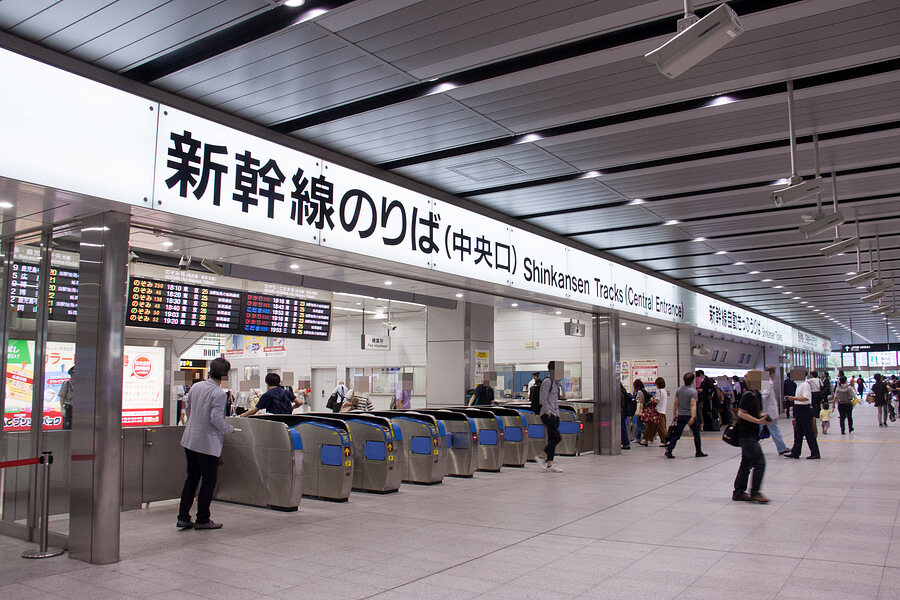
Existing photo of the Central Shinkansen gate. It is separate from the JR conventional-line transfer gate; follow signs for your actual connection.
JR West lists standard transfer times of 10 minutes for the listed JR conventional connections, 11 minutes for Osaka Metro, and 5 minutes between Shinkansen platforms, excluding same-platform Shinkansen changes. These are planning standards, not guaranteed door-to-door times. Add time for first-time navigation, lift routes, ticket collection, queues, children and luggage. Check any minimum connection required by your booking.
Shinkansen platforms are numbered 20–27, and JR conventional platforms 1–10. Do not memorize a fixed platform from an article: the current JR West guide includes more than a simple westbound/eastbound split, and some platforms serve different routes or special departures. Match your train number and destination to the live board.
Luggage, accessibility and station facilities
The JR West station information page confirms coin lockers, with a note that access can depend on their location. Size, availability, payment method and retrieval access are not guaranteed. If leaving bags, check whether the locker is inside or outside a paid area and whether you can reach it later.
The official maps identify toilets, lifts, ticket facilities and other services. Use the Metro accessible-route guide or ask station staff if you need a step-free route; it may differ from the shortest escalator route. Do not plan a tight change based on a photograph of an old floor directory.
For Shinkansen travel with a large suitcase, review the official luggage rules. Baggage with total three-side dimensions over 160 cm and up to 250 cm requires the appropriate reserved seat with baggage space on the applicable Shinkansen lines. Storing a bag at the station does not reserve space on your train.
Buying and collecting Shinkansen tickets
Check the exact train, route, seat, passenger details, full price and change/refund rules before purchasing. Our Shinagawa guide is useful for a Tokyo-area departure; the official Shinkansen timetable provides basic service information.
For a booking on Japan Train, follow the product's issued instructions and confirm whether collection is required. Seats and fulfilment depend on confirmation; this article does not promise a seat, universal QR delivery or a particular collection machine.
Smart EX's official boarding guide describes direct-entry QR tickets, assigned IC cards and paper-ticket pickup for its own reservations. These methods are not interchangeable with every agency booking. Check the seller's specified collection location and documents, and allow time before your train.
JR West's station page lists ticket offices and suitable ticket machines, but their hours and services differ. It notes that its Shinkansen transfer-gate ticket office sells tickets for same-day travel. Consult the current listing rather than assuming every counter performs every transaction.
Busy periods and connection buffers
Major holiday travel periods can be busy, but exact dates and service rules vary. Check the official all-reserved Nozomi notice for applicable peak periods. Reserve the correct train and any baggage space in advance where needed. A non-reserved product does not ensure an empty seat.
Build a larger buffer if you must collect a ticket or pass, meet another traveller, use lifts or change operators. Check operating information again on the day. No particular hour or season guarantees an uncrowded station.
JR Pass coverage and collection at Shin-Osaka
The nationwide JAPAN RAIL PASS covers eligible Hikari, Kodama, Sakura and other included services within its conditions. Nozomi and Mizuho require the valid nationwide pass together with the dedicated [ONLY WITH JAPAN RAIL PASS] NOZOMI MIZUHO Ticket for the applicable section and class. Do not substitute an ordinary seat reservation for that add-on.
Regional passes have different coverage. For example, the Kansai WIDE Area Pass includes eligible Sanyo Shinkansen travel between Shin-Osaka and Okayama but excludes the Tokaido Shinkansen between Shin-Osaka and Tokyo. Check the exact pass, not simply the JR company or train name.
There is no single collection counter for every pass and purchase channel. The nationwide pass's official exchange and pickup list includes several Shin-Osaka locations, including Travel Service Center SHIN-OSAKA and specified ticket offices; services differ by purchase method. JR West provides a separate pass exchange and receipt location finder for its products. Check the relevant list, required passport, booking documents and payment card where applicable.
For a JR-WEST ONLINE TRAIN RESERVATION purchase, the applicable product instructions may permit collection at a ticket machine or office with the specified details. Machine passport-reading and card requirements matter. Do not assume only the Travel Service Center can issue all passes, or that any Green Ticket Office can handle yours.
Where to eat: check the side of the gates
First decide whether you will eat before entering a paid area, during a JR connection or after going into the Shinkansen area. Restaurants in one area are not automatically accessible from another without passing a gate and considering ticket validity.
Arde Shin-Osaka is a shopping and dining area on 2F outside the JR gates. Its access guide directs arriving JR passengers to exit the gates and go to 2F; it is close to the Metro's Naka Gate. It is not inside the Shinkansen paid area.
Current Arde shop-directory examples include Shinobuan (しのぶ庵), a soba restaurant, and Takomasa (たこ昌), serving takoyaki. Use their official listings for current hours, menus and location; opening times and last orders can change.
Eki Marche Shin-Osaka is shown within the JR conventional-line concourse on the official station map. Do not treat a conventional-line restaurant as a Shinkansen-side shop. If your connection is short, consider buying food in the area you can already access rather than exiting merely to reach a named restaurant.
Visiting Osaka after arrival
Shin-Osaka is a transport base, not a promise that Osaka's main sights are next door. Dotonbori and Namba, Osaka Castle, Shinsekai, Universal Studios Japan and the Umeda area require their own onward route. Check the attraction's actual entrance and current access information before choosing a station or hotel.
For Namba and Tennoji, the Midosuji Line can be a useful starting point; for other destinations, compare a dated JR or Metro route. Allow for walking from the arrival station and do not assume one ticket or pass covers every operator.
Before entering the gate
- Confirm that the rail ticket names Shin-Osaka and the correct travel date.
- Identify whether your next train is Shinkansen, JR conventional rail or Metro.
- Complete required ticket/pass collection and check the boarding method.
- Read the train number, destination and platform on the current departure board.
- Check baggage arrangements and use the appropriate lift route if needed.
- Keep extra time for queues and unfamiliar navigation.
Frequently Asked Questions
Are Shin-Osaka and Osaka Station the same?
No. Shin-Osaka has the Shinkansen platforms; Osaka Station is a separate JR station in Umeda. Check the exact station on your ticket and plan any connecting JR or Metro journey.
How do I transfer from the Shinkansen to Osaka Metro?
Leave the Shinkansen paid area using the correct ticket procedure, then follow Midosuji Line signs to the separate Metro gates. Use the official Metro map for accessible routes. The Metro fare is separate from a JR pass.
How much time should I allow to change trains at Shin-Osaka?
JR West lists standard times of 10 minutes for its listed JR conventional connections, 11 minutes for Metro and 5 minutes between Shinkansen platforms, excluding same-platform changes. Add time for queues, ticket collection, lift routes, luggage and unfamiliar navigation; these are not guaranteed connection times.
Which platform will my Shinkansen use?
Shinkansen platforms are numbered 20–27, but the actual departure platform must be checked against your train number and time on the current display. Do not rely on a fixed platform assignment in an article or photograph.
Where do I collect a JR Pass at Shin-Osaka?
Use the official location list for your exact pass and purchase channel. Several designated Shin-Osaka offices or machines can have different services and requirements. Do not assume every pass must be collected at the Travel Service Center.
Can I use the nationwide JR Pass on Nozomi from Shin-Osaka?
Yes, with the valid nationwide JAPAN RAIL PASS and the dedicated NOZOMI MIZUHO additional ticket for your section and class, obtained before travel. An ordinary seat reservation alone is not the required add-on.
Does a Kansai WIDE Area Pass cover Shin-Osaka to Tokyo?
No. Its official conditions exclude the Tokaido Shinkansen between Shin-Osaka and Tokyo. Check coverage for your exact regional pass and buy the appropriate separate ticket when required.
Is Arde Shin-Osaka inside the Shinkansen gates?
No. Arde is on 2F outside the JR gates, close to the Metro Naka Gate. Check ticket validity before exiting a paid area and use the official shop listings for current hours.
Can I leave luggage in a locker at Shin-Osaka?
JR West lists coin lockers, but size, availability and access depend on the location. Check whether a locker is inside a paid area and whether you can retrieve your bag later; an empty locker is not guaranteed.
Can I use any booking QR code at the Shin-Osaka gate?
No. Follow the issued product's boarding instructions. A valid direct-entry QR ticket, an assigned IC card and a code for collecting paper tickets are different arrangements; a booking reference is not automatically a gate ticket.