March 2026 Yamagata Shinkansen “Tsubasa” Timetable Update | Japan Train
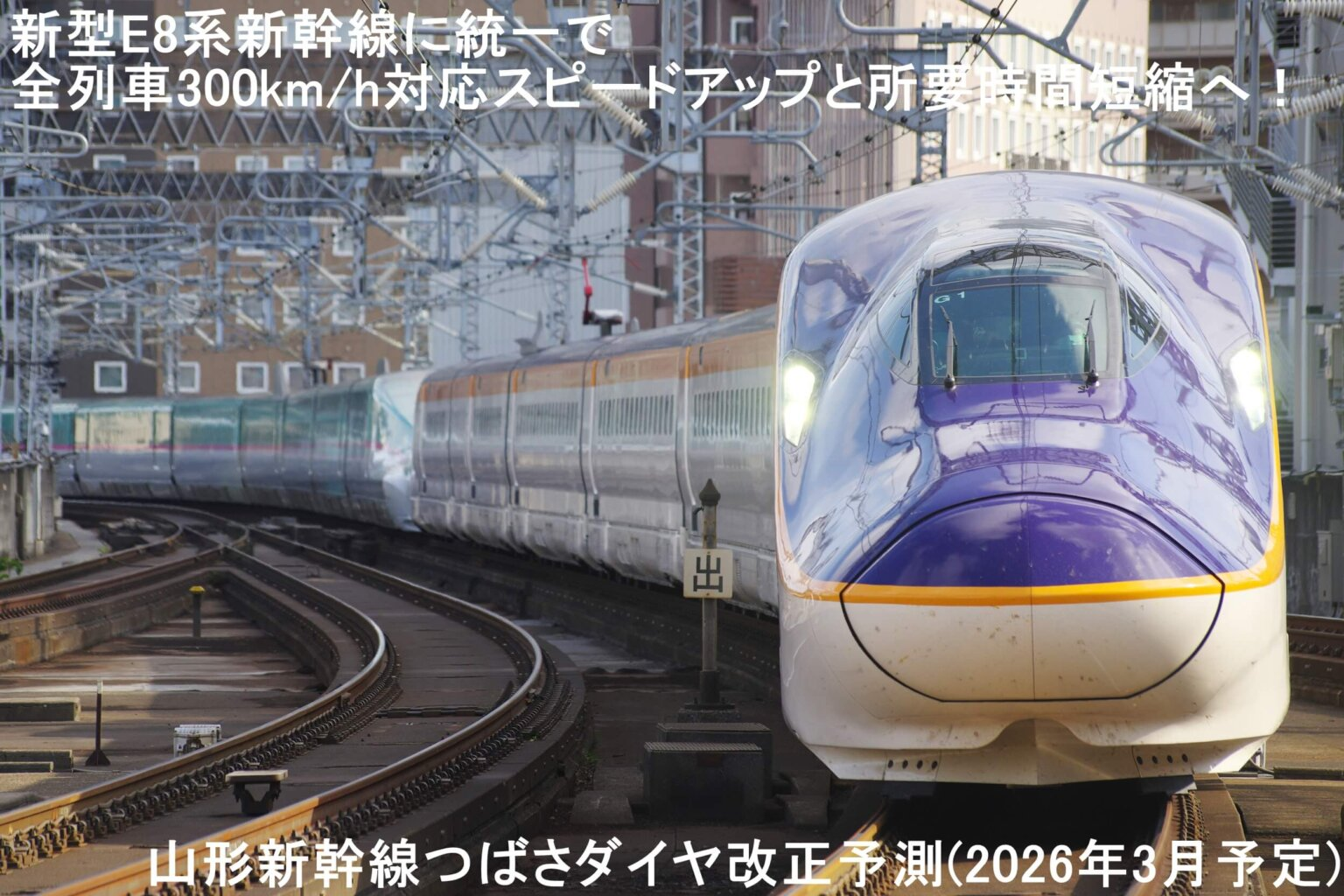
Table of Contents
- Yamagata Shinkansen "Tsubasa" to Fully Adopt New E8 Series Trains!
- Yamagata Shinkansen "Tsubasa" Journey Time Reduced by 4 Minutes; Tokyo Station Arrival/Departure Times Adjusted!
- Tokyo Station: First Departure Delayed / Last Departure Delayed; First Arrival Advanced / Last Arrival Advanced—Comprehensive Convenience Upgrade!
- Yamagata Shinkansen "Tsubasa" Maximum Speed Increased to 300 km/h, Possibly Paving the Way for Limited Express Fare Hikes?
- Conclusion
Yamagata Shinkansen "Tsubasa" to Fully Adopt New E8 Series Trains!
In the March 2026 timetable revision for the Tohoku Shinkansen and Yamagata Shinkansen, all Yamagata Shinkansen "Tsubasa" trains, including temporary services, will uniformly operate using the new E8 series Shinkansen trains.
The new E8 series Shinkansen can reach a maximum speed of 300 km/h, an improvement over the previous E3 series trains used on the Yamagata Shinkansen, which had a maximum speed of 275 km/h. As a result, when the E8 series is fully deployed, the journey time on the Tohoku Shinkansen section between Omiya and Fukushima will be reduced by 4 minutes.
Previously, due to a lack of sufficient backup trains for replacement, most "Tsubasa" services continued to use E3 series trains. Thus, only 2 out of the 16 regular round-trip services had achieved the reduced journey time.
However, with the March 2026 timetable revision, all "Tsubasa" services, including temporary trains, will fully adopt the E8 series capable of 300 km/h operations. This will enable a 4-minute reduction in journey time across the entire line using an E8-specific timetable! The standard travel time from Tokyo to Yamagata will be shortened from the current 2 hours 42 minutes to 2 hours 45 minutes to 2 hours 38 minutes to 2 hours 41 minutes, with the average time expected to break the 2-hour 20-minute mark. Although all services currently already operate within 2 hours 50 minutes from Tokyo to Yamagata (meeting the 3-hour comfort threshold for road/rail/air travel), the necessity for further reduction is relatively limited.
It is worth noting that despite the E8 series Shinkansen experiencing malfunctions in June 2026, leading to reduced services relying on E3 series trains until August, the plan to fully replace E3 series with E8 series by March 2026 remains on track.
Next, let’s focus on how the Tohoku Shinkansen timetable will be adjusted following the full implementation of 300 km/h operations for the Yamagata Shinkansen "Tsubasa"!
Yamagata Shinkansen "Tsubasa" Journey Time Reduced by 4 Minutes; Tokyo Station Arrival/Departure Times Adjusted!
So, how will the Tohoku Shinkansen timetable be revised in March 2026 with the full adoption of the E8 series for the Yamagata Shinkansen "Tsubasa"?
Looking back at the timetable revisions on March 16, 2026, and March 15, 2026, journey times for approximately 2 "Tsubasa" services were shortened through schedule adjustments: while maintaining the same travel time on the Ou Main Line section between Fukushima and Yamagata, southbound trains to Yamagata departed Tokyo 4 minutes later, and northbound trains to Tokyo arrived 4 minutes earlier. This was necessary to coordinate train crossings at Fukushima Station’s Platform 14 and the single-track section of the Ou Main Line. Simply adjusting the schedule by 4 minutes could disrupt the train crossing system.
Considering the constraints on arrival and departure slots at Tokyo Station, previous adjustments achieved optimization through schedule swaps. It is expected that this revision will also adapt the system by adjusting arrival and departure times at Tokyo Station.
Tokyo Station: First Departure Delayed / Last Departure Delayed; First Arrival Advanced / Last Arrival Advanced—Comprehensive Convenience Upgrade!
How will the first and last train services change after the journey time reduction for the Yamagata Shinkansen "Tsubasa"?
As mentioned, despite slot constraints at Tokyo Station, previous adjustments for the "Tsubasa" were made through schedule swaps. Following this pattern, here are the predicted changes:
- First train departing Tokyo: "Tsubasa 121" bound for Shinjo is expected to be delayed from 6:12 to 6:16. This will require corresponding adjustments to the schedules of conventional line trains arriving at Tokyo Station.
- First train departing Yamagata: "Tsubasa 122" bound for Tokyo, departing Shinjo at 5:40, is expected to arrive 4 minutes earlier, at 9:08 instead of 9:12. Additionally, "Tsubasa 172" bound for Tokyo, departing Yamagata at 5:59 on Saturdays, is expected to arrive at 8:40 instead of 8:44.
- Last train departing Tokyo: "Tsubasa 159" bound for Yamagata is expected to be delayed from 20:44 to 20:48; "Tsubasa 157" bound for Shinjo will be delayed from 19:16 to 19:20.
- Last train arriving in Tokyo: "Tsubasa 160" bound for Tokyo, departing Shinjo at 19:57, is expected to arrive at 23:24 instead of 23:38. This will require adjustments to connecting conventional line services at Tokyo Station, with some stations seeing earlier final arrival times. An earlier return home is always welcome.
However, since all "Tsubasa" services are scheduled alongside Tohoku Shinkansen "Hayabusa" trains operating between Tokyo and Sendai, the changes will not affect the first and last train times on the Tokyo-Fukushima section. Additionally, there are no planned schedule changes for the Fukushima-Yamagata section of the Yamagata Shinkansen "Tsubasa." Purely from a passenger perspective, this will allow more people to use the service while reducing travel time—a win-win situation.
Yamagata Shinkansen "Tsubasa" Maximum Speed Increased to 300 km/h, Possibly Paving the Way for Limited Express Fare Hikes?
By March 2026, the Yamagata Shinkansen "Tsubasa" will replace its 15 seven-car E3 series trains with 15 E8 series trains. Although the increased speed reduces journey time, the number of operating trains remains unchanged. Moreover, with the E8 series having fewer seats, the likelihood of selling non-reserved limited express tickets may increase, potentially reducing revenue.
Why, then, pursue such a seemingly irrational speed increase? If the goal were merely to improve delay recovery or schedule flexibility, it could be achieved through double-tracking improvements at Fukushima Station.
The only plausible reason for this marginally beneficial speed increase is: to justify hiking limited express fares.
Since the Tohoku Shinkansen speed increase on March 5, 2011, even "Hayabusa" trains operating at 300 km/h and making stops north of Sendai have been charging (surcharges) based on a 320 km/h standard. Similarly, if all "Tsubasa" services operate at 300 km/h, it is likely that附加费 will be imposed.
Even if are applied to "Tsubasa" services, the actual additional cost would only be 210 yen for the Utsunomiya-Fukushima segment. When the Yamagata Shinkansen fully implemented reserved seating on March 12, 2022, fares were reduced by 100 yen. This fare adjustment appears aimed at recouping the revenue lost from that reduction.
Conclusion
With the March 2026 timetable revision for the Tohoku Shinkansen and Yamagata Shinkansen, the full adoption of the E8 series for the Yamagata Shinkansen "Tsubasa" will enable 300 km/h operations for all services, reducing journey times by 4 minutes.
Given the speed increase to 300 km/h, limited express fares for the Yamagata Shinkansen "Tsubasa" are expected to rise by up to 210 yen.
As new trains are progressively introduced, we look forward to seeing how the Tohoku Shinkansen will further optimize its timetable arrangements in the future.