March 2026 JR East Timetable Update: Negishi Line ATO & More Yokohama Line Services | Japan Train
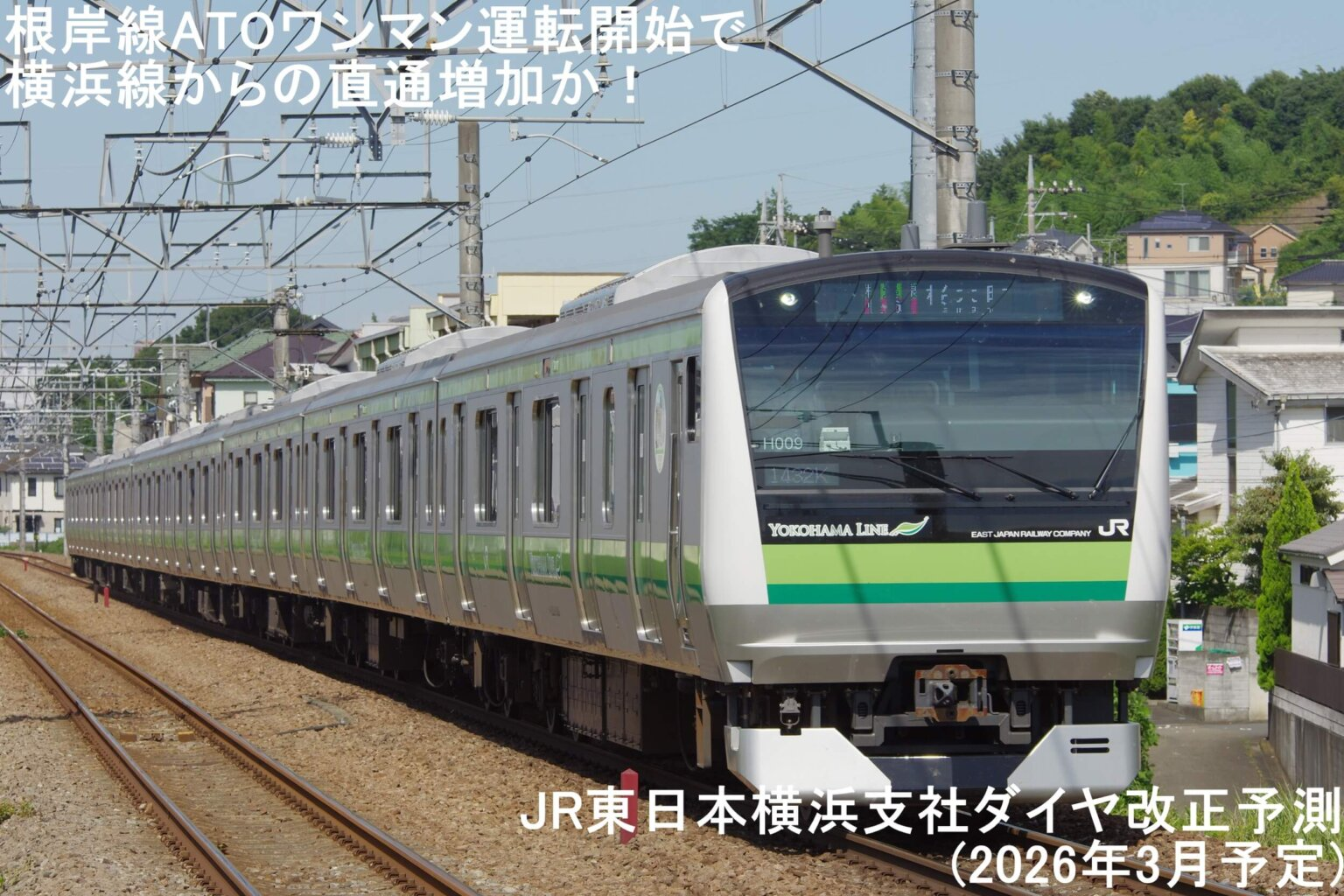
Table of Contents
- ATO One-Person Operation to Begin on the Negishi Line!
- Expansion of One-Person Operation Possibly Set Through Increased Through Services from the Yokohama Line to the Negishi Line!
- Data Collection for ATO Automatic Operation on the Keihin-Tohoku Line and Yamanote Line?
- Conclusion
ATO One-Person Operation to Begin on the Negishi Line!
JR East will commence ATO (Automatic Train Operation) on the Negishi Line between Higashi-Kanagawa and Ōfuna from November 22, 2026.
The reason for implementing it on the Negishi Line is the absence of level crossings. Fundamentally, ATO is often adopted on sections without level crossings, such as subways, where track conditions are less susceptible to changes from rain or snow, making it easier to introduce as the automatic operation pattern remains consistent.
However, this time, JR East has decided to introduce ATO on the Negishi Line, which runs above ground. For reference, on China's Beijing Subway Yanfang Line, which opened on December 30, 2017, unattended automatic operation via ATO is conducted even on elevated sections, so with 2026 technology, it is certainly feasible.
The E233-6000 series 8-car sets equipped with this ATO are primarily for the Yokohama Line, with some trains operating through services onto the Negishi Line. However, as the Yokohama Line has level crossings on almost all sections between stations, requiring ATC and TASC, it has reached its limits, and with current technology, ATO automatic operation is not possible. Therefore, ATO will be implemented only on the level-crossing-free Negishi Line.
One peculiar point is that although the Yokohama Line 8-car sets operate on the Negishi Line, most terminate at Sakuragichō, just two stations beyond Higashi-Kanagawa, with only a very few continuing to Isogo or Ōfuna. Furthermore, while these 8-car sets on both the Yokohama and Negishi Lines are expected to begin one-person operation from the March 2026 timetable revision, ATO is not absolutely essential for implementing one-person operation – evidenced by its absence on the Nambu Line's E233-8000 series. For just two stations, having the driver operate manually wouldn't be significantly different, and retrofitting the ATO equipment onto the E233-6000 series likely incurred considerable cost. Frankly, it's hard to see the investment being recouped from just the round trip between Higashi-Kanagawa and Sakuragichō.
So why was the ATO automatic operation system installed on the Yokohama Line's E233-6000 series 8-car sets, even for limited use?
Expansion of One-Person Operation Possibly Set Through Increased Through Services from the Yokohama Line to the Negishi Line!
So, why was the decision made to install the costly ATO system on the Yokohama Line's E233-6000 series 8-car sets for the upcoming March 2026 timetable revision?
One reason could be the early expansion of one-person operation on the Negishi Line.
During daytime hours, the schedules for the Keihin-Tohoku Line trains (running between Minami-Urawa and Isogo) and the Yokohama Line local trains (running between Hachioji and Sakuragichō) are separated by only about 2 minutes.
Moreover, on the Negishi Line during the day, Ōfuna-bound trains run every 10 minutes, interspersed with Isogo-bound trains running every 20 minutes. This creates gaps of up to 10 minutes, and the Isogo-bound trains, having short headways with preceding trains and a short operational segment, are often very empty between Yokohama and Isogo on the Negishi Line. Even if the Isogo-terminating trains were shortened from 10 cars to 8 cars during the day, there would be no issue with transport capacity.
Therefore, might they swap the daytime Keihin-Tohoku Line trains (terminating at Isogo) with the Yokohama Line local trains (terminating at Sakuragichō), reorganizing services into Keihin-Tohoku Line trains running between Minami-Urawa and Sakuragichō and Yokohama Line trains running between Hachioji and Isogo?
This would increase the number of one-person operated trains on the Negishi Line (between Yokohama and Isogo) to 3 per hour during the day. It would also increase through services to Shin-Yokohama from Isogo and Kannai, improving access to the Tokaido Shinkansen. Additionally, establishing 3 trains per hour from Sakuragichō towards Tokyo could boost real estate prices due to the "starting station effect."
While the Keihin-Tohoku Line is also scheduled for one-person operation a year later in March 2027, meaning all Negishi Line trains will eventually be one-person operated anyway, reducing the consist length from 10 to 8 cars for the 3 trains per hour between Sakuragichō and Isogo would lower electricity consumption, benefiting the environment. Passengers for the Keihin-Tohoku Line towards Tsurumi, Kawasaki, and Ōimachi can simply cross the platform to transfer at Sakuragichō or Higashi-Kanagawa. Conversely, having direct trains to Shin-Yokohama during the day from stations between Kannai and Isogo would improve Shinkansen access and potentially increase real estate values. Considering this, extending the Yokohama Line 8-car sets to Isogo during the day would not only reduce costs but also enhance convenience.
Data Collection for ATO Automatic Operation on the Keihin-Tohoku Line and Yamanote Line?
Another possible reason is data collection for implementing ATO automatic operation on other lines.
The E233-1000 series 10-car sets, which also operate on the Keihin-Tohoku Line (which shares tracks with the Negishi Line), run on sections without level crossings between Ōmiya and Kita-Akabane and between Ōji and Shinagawa. This means ATO could be introduced on about 80% of the line, though not entirely.
Additionally, the Yamanote Line has only one level crossing between Komagome and Tabata, and if that were removed, the line would be entirely free of level crossings. JR East is aiming for one-person operation on the Yamanote Line by 2031, with driverless operation even being considered.
However, both the Yamanote and Keihin-Tohoku Lines are vital arteries running through central Tokyo. Introducing new systems on these lines carries high risk; if malfunctions cause suspension of services, the impact would be significant. Recall that on the first day of revenue service for the current Yamanote Line E235 series, a malfunction in the train control/monitoring system (INTELOS) rendered trains inoperable, leading to service suspension on the Yamanote Line.
Therefore, JR East might be using the level-crossing-free Negishi Line to test ATO automatic operation, validating new technologies intended for the Yamanote Line on another route first.
Conclusion
The upcoming March 2026 timetable revision by JR East's Yokohama Branch may involve an expansion of through services from the Yokohama Line to Isogo on the Negishi Line.
It will be interesting to see what kind of timetable changes are implemented for the Yokohama, Negishi, Keihin-Tohoku, and Yamanote Lines as they progress towards one-person operation.