HC85 Series, Kuroshio Split & 283 Series Retirement: A 2028 Forecast for the Kisei Main Line.
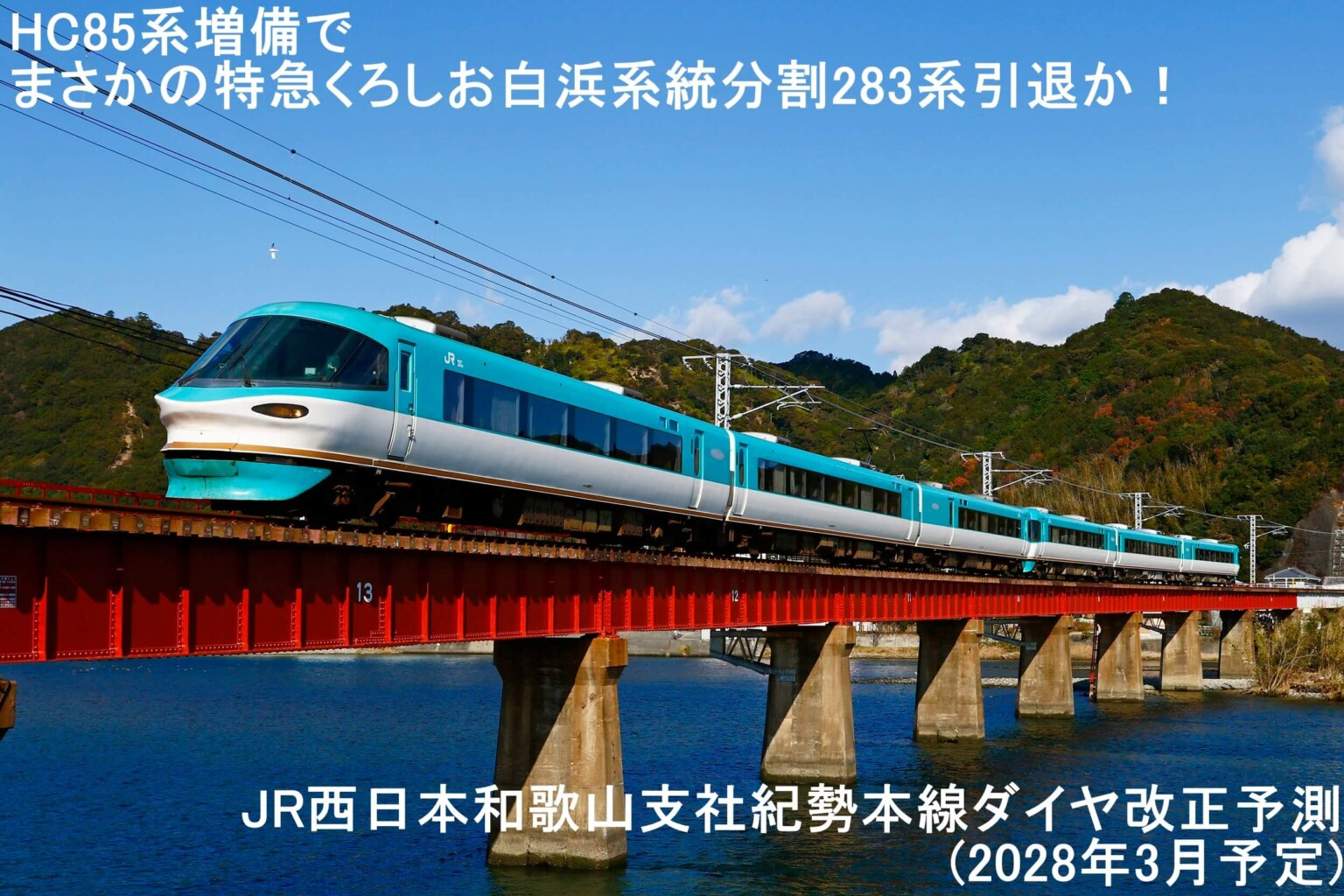
Table of Contents
- 1.HC85 Series: 6 Additional Cars to be Introduced!
- 2.Will the HC85 Series be Deployed on the JR West Kisei Main Line, Leading to a Split and Replacement of the Limited Express "Kuroshio"?
- 3.Expansion of the Limited Express "Nanki" to the Nagoya–Shirahama Section: Cheaper Access to Tokyo via Tokaido Shinkansen Transfer!
- 4.Conclusion
HC85 Series: 6 Additional Cars to be Introduced!
For the upcoming March 2028 JR Central timetable revision, six additional HC85 series diesel cars for the Takayama Main Line Limited Express "Hida" and the Kisei Main Line Limited Express "Nanki" will be introduced. This introduction by JR Central will consist of one 4-car set and one 2-car set, totaling six cars.
Normally, one would assume these are for increasing capacity on the Takayama Main Line Limited Express "Hida".
However, considering the surrounding line conditions, they might instead be destined for the Kisei Main Line limited express services.
Will the HC85 Series be Deployed on the JR West Kisei Main Line, Leading to a Split and Replacement of the Limited Express "Kuroshio"?
This leads to the surprising possibility of JR Central's HC85 series diesel cars partially replacing JR West's Limited Express "Kuroshio".
As of 2023, the Kisei Main Line Limited Express "Kuroshio" operates using three types: the 283 series, 287 series, and 289 series, all in 6 or 9-car formations. Among these, the 283 and 287 series were newly manufactured for the Kisei Main Line limited express services, while the 289 series are former 683 series sets used for the Hokuriku Main Line Limited Express "Shirasagi".
The 283 series ("Ocean Arrow" type) introduced in 1996 consists of only two 6-car sets and two 3-car sets. Their tilting mechanism makes maintenance cumbersome. Although initially introduced as capable of 130 km/h operation on the Kisei Main Line, they could only achieve this speed on very limited sections, and the maximum speed on the line was reduced to 110 km/h from 2022. Thus, they are ready to be replaced by other types at any time.
Discontinuing the "Kuroshio" service on the Shirahama–Shingu section would free up two operational diagrams. By 2028, the 283 series ("Ocean Arrow" type) will be 32 years old, making their retirement unsurprising.
Might the plan be to replace JR West's 283 series Ocean Arrow type with JR Central's HC85 series diesel cars?
Furthermore, if the Shirahama–Shingu section service is replaced by a turnaround operation, schedule adjustments suggest that approximately two diagrams would suffice.
JR Group companies manage operational coordination based on train kilometerage. Currently, to adjust train kilometers for a mere 14.9 km one-way through operation within the JR West area, it's necessary to run a special "Nanki" service over a long 208.8 km one-way section within the JR Central area. If this can be changed to a turnaround service solely within the JR West area (Shirahama–Shingu), it would reduce wasteful empty stock movements within JR Central's network. Therefore, for JR Central, even though it involves using their own rolling stock for another company's limited express service, the reduction in actual empty running losses and associated crew diagram losses outweighs the cost. Additionally, as mentioned later, travel from Kushimoto to Tokyo would shift from using the "Kuroshio" and transferring to the Tokaido Shinkansen at Shin-Osaka to using the "Nanki", increasing the travel distance within JR Central's network and thereby increasing fare and charge revenue, which is not unfavorable for JR Central.
Moreover, the HC85 series diesel cars are 2-car sets with a capacity of 100 passengers. The total passenger number for the upbound "Kuroshio" services from Shirahama–Shingu to Shin-Osaka in FY2023, as published by JR West, was 313. Dividing this by the 5 daily regular services gives an average of about 62 passengers per train; even with fluctuations, a 2-car HC85 set with 100 seats is sufficient. The current 6-car formations are significantly underutilized. Rather than reducing the 5 daily round trips, reducing the number of cars per set is preferable.
Furthermore, the 283, 287, and 289 series cannot operate as one-person trains, whereas the HC85 series has already been operating as such within JR West's network since the March 16, 2024, timetable revision. Also, the JR Central HC85 series is an electric-type diesel car without a clutch, operable by drivers with an electric multiple-unit (EMU) license. Thus, simply replacing the "Kuroshio" with the "Nanki" service on the Shirahama–Shingu section allows for reduced crew requirements!
Considering this, is it not likely that the March 2028 JR West Wakayama Branch timetable revision will split the Kisei Main Line Limited Express "Kuroshio" at Shirahama and replace the service on the Shirahama–Shingu section with a 2-car, one-person operated limited express using HC85 series diesel cars?
Expansion of the Limited Express "Nanki" to the Nagoya–Shirahama Section: Cheaper Access to Tokyo via Tokaido Shinkansen Transfer!
How would the proposed split of the "Kuroshio" service at Shirahama affect passenger convenience?
First, for travel towards Osaka/Wakayama: The split would require a transfer for passengers from stations between Susami and Shingu. However, efforts would likely be made at Shirahama Station to facilitate a quick cross-platform or same-platform transfer. The limited express charge would be calculated continuously using the through limited express ticket system, so the total cost would remain the same, posing no significant problem.
Second, for travel towards Nagoya: If 2-3 round trips are extended through to the Nagoya–Shirahama section as the "Nanki", it would become a long-distance limited express covering 326.3 km (8th longest in Japan) in about 5 hours 10 minutes (3rd longest duration). This eliminates the need for a transfer and requires only one limited express ticket. Furthermore, the limited express fare zones jump from 'up to 200 km' to 'up to 300 km'. The operational distance between Nagoya and Shingu is 208.8 km, meaning the standard limited express fare for conventional lines for the Nagoya–Shingu/Kii-Katsuura section (2,950 yen for a standard-class reserved seat during normal periods) would now cover travel all the way to Kushimoto/Susami. This could make the fare about 1,290 yen cheaper compared to the current scenario requiring a transfer between the "Kuroshio" and "Nanki" at Kii-Katsuura.
Finally, for access to Tokyo via the Tokaido Shinkansen: The total travel time from Kushimoto to Tokyo is virtually the same whether using the "Kuroshio" and transferring at Shin-Osaka or using the "Nanki" and transferring at Nagoya. Despite a longer segment on the slower conventional limited express, the total journey time remains similar because the operational distance is shortened by 149.1 km, leading to reductions in the base fare and Shinkansen limited express charge. Consequently, the total one-way fare from Tokyo to Kushimoto for a standard-class reserved seat during normal periods would drop from 19,760 yen to 18,500 yen, a reduction of 1,260 yen, with almost no change in travel time. (Note: The planned abolition of the 10% round-trip discount from March 14, 2026, will effectively increase the per-trip cost by 1,100 yen for round-trip users, but the net cost is still projected to be lower than in 2025.)
Considering these points, splitting the "Kuroshio" at Shirahama and extending the "Nanki" to operate between Nagoya, Shingu, and Shirahama would minimally impact convenience for Osaka/Wakayama-bound travelers while significantly improving it for those heading to Nagoya and Tokyo. Even from a local resident's perspective, the split seems likely to enhance overall convenience.
Conclusion
The March 2028 JR West Wakayama Branch timetable revision may involve splitting the Kisei Main Line Limited Express "Kuroshio" at Shirahama. The service on the Shirahama–Shingu section could be converted to 2-car JR Central HC85 series sets, down from the current 6-car formations of the 283, 287, and 289 series, aiming to maintain service frequency while potentially retiring the 283 series Ocean Arrow type trains.
We look forward to seeing what kind of timetable revisions the JR West Wakayama Branch will implement.