Japan Bullet Train Guide: Shinkansen Speeds, Seats & Tickets

The Shinkansen, often called Japan's bullet train, is a high-speed rail network operated by JR railway companies. The Tokaido Shinkansen opened in 1964. This guide explains how the trains work, what their speed figures mean, and how to choose stations, seats and tickets for a trip.
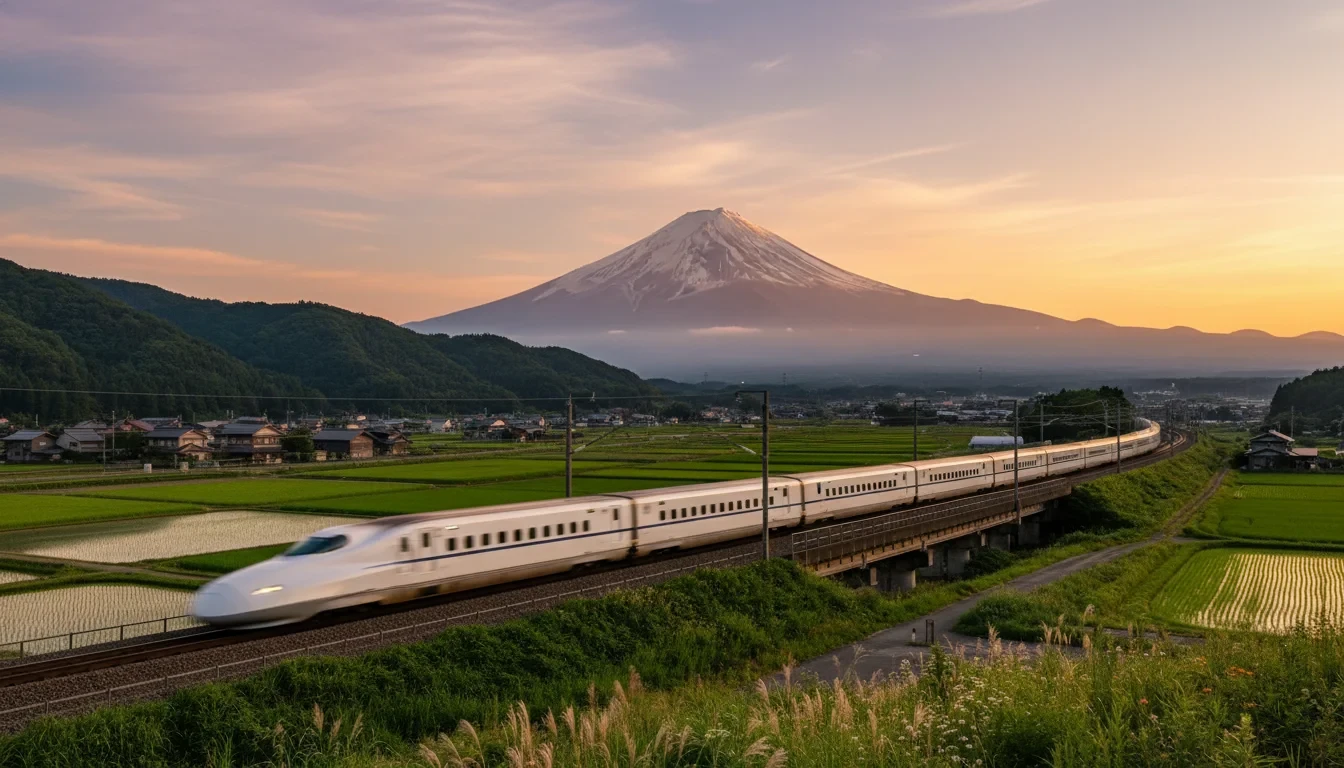
What the Shinkansen Is (and What It Is Not)
Choose the line and boarding station for your destination first. A city name and its Shinkansen station name can differ: Tokaido trains use Shin-Osaka, for example. Consult the operator's route map and the stops of your selected train rather than assuming every bullet train calls at every station.
For travel further into Hokkaido, plan the onward connection separately: the Hokkaido Shinkansen stations currently end at Shin-Hakodate-Hokuto.
How Bullet Trains Work
High speed comes from the railway and train working together. JR Central describes aerodynamic train design, a route designed to reduce sharp curves, and Automatic Train Control (ATC) as key parts of the Tokaido system. JR East's E5 train design uses a long nose and noise-control features to limit tunnel pressure waves and noise at high speed. These design principles help explain how bullet trains work; they do not guarantee uninterrupted service.
Shinkansen Speeds: What Each Line Actually Runs
Speed depends on the line and train. JR Central lists a maximum of 285 km/h for the Tokaido Shinkansen. JR East lists 320 km/h for the E5 series, a train used on Tohoku and Hokkaido services; that maximum is reached on eligible Tohoku sections, not across its whole route.
The E5 figure does not describe the N700S on the Tokaido line. A train's maximum speed also differs from its average journey speed. Use the selected departure's timetable for arrival time rather than calculating a journey from a headline speed.
Safety, Seismic Protection and Punctuality
JR Central's Tokaido safety and operating overview describes continuing investment in safety facilities and staff training. Its safety record concerns that operator and line; it is not a promise about every train or future journey.
The same page reports 1.6 minutes of average delay per Tokaido train in FY2023, including natural-disaster delays. This is a dated annual statistic, not a current network-wide average or a guarantee of punctuality. Allow time for connections and check current operation notices when travelling.
Onboard Comfort, Seating and Ekiben
Seat layout and facilities depend on the train and class. Use the operator's current seat information when space, power or accessibility matters to your trip. An ekiben station lunchbox can be part of the journey; buy refreshments before boarding and keep noise low for fellow passengers.
Seat Classes Explained
Ordinary car is the standard travel class. Green car is a higher class with a separate charge. Reservation options depend on the service.
Premium products are specific to particular trains: GranClass is shown on the E5, while JR Central describes Supreme Class as a separate Tokaido product. Do not assume there are three universal classes or that a premium product is available through every seller; confirm the exact train and sales channel.
Reserved vs Non-Reserved Seats
Reserved seating (指定席, shiteiseki) assigns you a specific car and seat number. Non-reserved seating (自由席, jiyūseki) is sold only on services where it is offered, and a seat is not guaranteed — on busy trains you may need to stand or wait for a later departure. All-reserved services exist, including the Hayabusa and Hayate trains on the Tōhoku and Hokkaidō routes, where every seat is reserved.
How Shinkansen Tickets Are Priced
Most Shinkansen fares in Japan are built from more than one component. As JR Central sets out in its ticket combination guidance, a standard journey normally requires:
- Basic fare (rail fare) — the charge for travelling between two stations;
- Shinkansen limited express charge — the fee for using the high-speed service itself, with reserved-seat surcharges where applicable;
- Green car surcharge — added only when travelling in a Green car.
When you see a single total price quoted on a booking site or ticket machine, that figure may already bundle these components together. The fare conditions and sales terms shown at the moment of purchase are what govern your ticket; check what is included before you pay. For corridor-specific pricing examples, see our guide to Tokyo–Kyoto Shinkansen prices and the comparison in Tokyo to Osaka by Shinkansen.
Buying Tickets and Planning Your Journey
Tickets can be purchased at station ticket counters, ticket machines, and through online reservation platforms. If you are travelling during Japanese holiday periods, popular trains can fill up, so reserving a seat in advance is the lower-risk option. For navigating the largest hub on the network, use our Tokyo Station map and guide to find the Shinkansen platforms and transfer routes.
The Japan Rail Pass and Shinkansen Services
The nationwide JAPAN RAIL PASS covers many Shinkansen journeys, subject to its conditions. Nozomi and Mizuho require a qualifying additional ticket bought before boarding and used with a valid pass for the specified segment and accommodation. Check the official pass scope; regional passes have their own terms. Compare your itinerary in our JR Pass price guide.
Major Shinkansen Lines and Where They Go
These examples help identify a corridor; they are not a complete network map or a list of all stops.
| Line | Main journey | Planning detail |
|---|---|---|
| Tokaido | Tokyo–Nagoya–Shin-Osaka | Use Shin-Osaka for the Osaka Shinkansen stop. |
| Tohoku / Hokkaido | Tokyo–Shin-Aomori–Shin-Hakodate-Hokuto | Check which train continues into Hokkaido. |
| Joetsu | Tokyo–Niigata | GALA Yuzawa station is seasonal. |
| Hokuriku | Tokyo–Nagano–Kanazawa–Tsuruga | Kanazawa–Tsuruga opened in 2024. |
Eating and Drinking on Board
Buy food and drinks before boarding, eat considerately and keep your seat area tidy. Onboard sales vary by operator and service; JR Hokkaido explicitly states that there are no onboard sales in its Hokkaido Shinkansen section. Do not rely on a trolley being available.
Wi-Fi, Power and Connectivity
Check the operator's information for Wi-Fi and power on your selected train. Availability and connection quality can vary. Download your ticket or collection instructions and station information in advance, and charge your device before departure if you depend on it.
Luggage Rules on the Shinkansen
Measure luggage by length + width + height. For ordinary suitcases on the Tokaido, Sanyo, Kyushu and Nishi Kyushu Shinkansen, luggage over 160 cm and up to 250 cm requires the appropriate oversized baggage arrangement; luggage over 250 cm cannot be taken on board. Check JR Central's current luggage rules for storage, reservations and special-item exceptions.
JR East has a separate luggage policy, with no suitcase storage reservation required within its stated limits. Do not automatically apply the Tokaido reservation rule to Joetsu or Hokuriku. Our baggage guide explains the differences.
Frequently Asked Questions
What is the Shinkansen?
It is Japan's JR high-speed rail network, commonly called the bullet train. Choose a line and boarding station for your destination, then check the stops of the particular train.
How fast does the Shinkansen go?
The Tokaido line has a maximum of 285 km/h. JR East lists 320 km/h for the E5 series, reached on eligible Tohoku sections. Maximum speed is not the average speed of a whole journey.
Is the Shinkansen really that punctual?
JR Central reports 1.6 minutes of average delay per Tokaido train in FY2023, including natural-disaster delays. This dated statistic does not guarantee an individual arrival; allow time for connections.
Can you eat on a Shinkansen?
Bring refreshments for your journey and eat considerately. Buy them before boarding rather than relying on onboard sales; availability differs by service.
Is there Wi-Fi on the Shinkansen?
Check the operator's current information for your train. Do not depend on uninterrupted connectivity; download ticket instructions and station information in advance.
Which areas does the Shinkansen network cover?
Different lines serve different corridors. Examples include Tokaido for Tokyo–Shin-Osaka, Joetsu for Tokyo–Niigata, and Hokuriku for Tokyo–Tsuruga. The Hokkaido Shinkansen currently reaches Shin-Hakodate-Hokuto; onward journeys need separate planning.
Do I need a reserved seat?
A reserved ticket assigns a specific seat on a specified train. Non-reserved tickets are available only where offered and do not guarantee a seat. Hayabusa and Hayate services are all reserved.
What makes up a Shinkansen ticket price?
A typical total includes the basic fare and Shinkansen limited express charge, plus a Green car charge when selected. A quoted total may bundle these; check inclusions and ticket conditions before paying.
Can I use the Japan Rail Pass on every Shinkansen train?
Check the exact pass terms. Nationwide JAPAN RAIL PASS holders need a qualifying additional ticket before boarding Nozomi or Mizuho, together with a valid pass. Regional passes have separate conditions.